Corporate Event Budget Template: A Worked Example
A corporate event budget should separate fixed costs, per-person costs, committed spending and remaining estimates. State the currency and tax basis, label assumptions and assign an owner to each cost. Use a base attendance scenario and test what changes when the guest count moves.
In this guide
Define what the budget includes
Before collecting quotes, agree whether the budget includes staff travel, internal labour, accommodation, production, speaker expenses and follow-up. Two event budgets can look very different because they measure different scopes, not because one organiser is more efficient.
Use one currency for the working budget and label any converted supplier quote with the rate and date used. Ask your finance team how tax should be presented. Do not mix tax-inclusive estimates with tax-exclusive quotes without explaining the difference.
A worked example for 80 attendees
The following numbers are fictional planning assumptions in EUR, excluding tax. They are not supplier quotes or industry benchmarks. Their purpose is to show how a change in attendance affects the calculation.
| Item | Calculation | EUR |
|---|---|---|
| Venue | Fixed | 2,400 |
| AV and production | Fixed | 1,200 |
| Speaker travel | Fixed allowance | 600 |
| Food and refreshments | 80 × 48 | 3,840 |
| Materials | 80 × 6 | 480 |
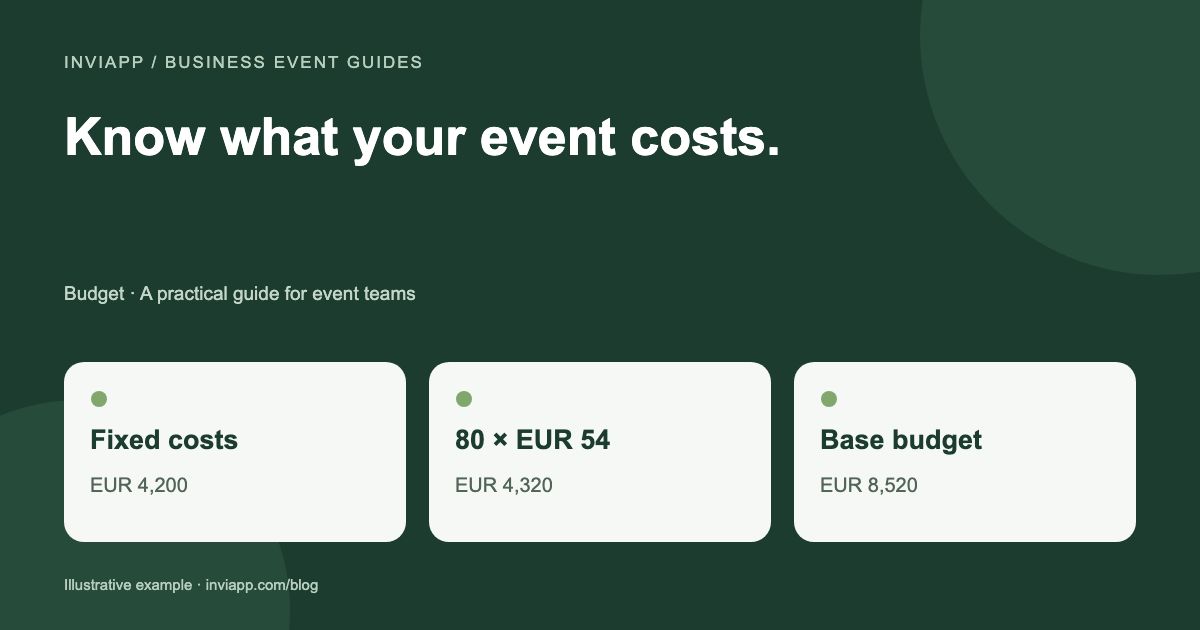
| Base total | 4,200 + 80 × 54 | 8,520 |
| Illustrative contingency | 10% of base | 852 |
| Planning total | Base plus contingency | 9,372 |
The 10% contingency is an example choice, not a recommended percentage for every event. Choose an allowance based on the uncertainty in your own bookings, quantities and change terms.
At 100 attendees, the same example becomes EUR 9,600 before contingency: EUR 4,200 of fixed costs plus 100 × EUR 54. That is only valid if the larger group does not trigger another room, additional technicians or different staffing. Real cost models often have thresholds as well as per-person rates.
Track estimates separately from commitments
Add columns for estimated cost, approved amount, committed amount and final actual cost. A signed supplier order is different from an informal estimate, and a deposit is not necessarily the full amount owed. Record payment dates separately from the total commitment.
Use a notes column for cancellation terms, minimum numbers and what is not included. Ask suppliers to identify overtime, delivery, setup and other possible additions. A low headline quote is not a useful comparison if the assumptions differ.
Give every row an owner who can confirm the latest figure. Keep the approval decision with the person authorised to make it rather than treating a spreadsheet entry as purchasing approval.
Connect the budget to a defined headcount
Keep invited people, confirmed attendees, companions and expected arrivals distinct. Do not multiply the total invitation list by a catering rate unless that is the actual basis of the supplier agreement. Set the final guest-count review before the supplier’s commitment deadline.
The RSVP management guide explains how to prepare an operational guest list. If you need a clearer source of current responses, compare the trade-offs in spreadsheets versus event registration software.
Use the editable budget worksheet
Download the example budget worksheet (CSV). Open it in your spreadsheet tool, replace the fictional quantities and rates, and add your approval and commitment columns. The file contains example values rather than spreadsheet formulas; check and maintain calculations in your working copy.
Before approving the budget, review one lower-attendance scenario and one higher-attendance scenario. Identify which costs remain payable if the event changes. This review often reveals a more important risk than whether one line item is slightly over its initial estimate.
Reconcile after the event
Match actual supplier invoices to the scope that was approved. Explain material differences, such as extra production hours or a changed guest count. Record the reason so that the next organiser learns from it instead of copying a number with no context.
Cost per attendee is useful only with a clear definition. State whether the denominator is confirmed registrations or observed attendance. The event metrics guide helps keep those measures consistent.
Frequently asked questions
What does an event budget template need?
Include the item, owner, quantity, rate, currency, tax basis, estimate, commitment, actual cost and assumptions. Add payment deadlines when cash timing matters.
Should contingency be spent in advance?
Keep it visible as an allowance for uncertainty. Reclassify an approved change into the relevant cost item so that the budget still shows what was purchased.
Does a lower cost per attendee mean a better event?
Not on its own. Compare the budget with the event’s purpose, audience and delivery requirements. A useful outcome and an accurate cost record are both needed to judge the decision.
Continue planning
Plan your next event
Bring the invitation, practical details and guest responses together on a branded event page. Explore InviApp for business events or review Business pricing.